Monday, December 22, 2025

The Trump Class Battleship

This is not a Cold War Story, but I am not starting up another blog site, and Cold War Stories is the nearest on topic.  <edited for clarity>

Dec 22, 2025, our incompetent-commander in chief has made an announcement of the Trump class "Battleship."
To quote, "We haven't built a battleship since 1994. These cutting-edge vessels will be some of the most lethal surface warfare ships"...
..."Each ship would displace more than 30,000 tons to 40,000 tons and serve as a flagship of the U.S. fleet."

"These battleships would be equipped with advanced weapons, including hypersonic missiles, electric rail guns and high-powered laser systems, as well as nuclear-capable sea-launched cruise missiles currently under development."

And finally, "start procuring two ships, working up to 10 and eventually 20 ships to 25 ships in total, and would aim to have the first two within two and a half years. "

What is wrong with this statement? 

"We haven't built a battleship since 1994." The truth is, the US hasn't completed a battleship since 1944.

I don't know what they told him was completed in 1994. Launched that year was a helicopter carrier, a mine sweeper and a few submarines and several Arleigh Burke destroyers. The first of it's class was commissioned three years earlier. At around 9,000 tonnes*, the Arleigh Burkes are large for destroyers, but far smaller than the 45,000 tonnes of an Iowa class battleship.

"Each ship would displace more than 30,000 tons to 40,000 tons." 30 to 40,000 tonnes IS in the battleship range. The class previous to the Iowa was 35,000. This is in line with many of their contemporaries in WWII. But the term battleships has to do with not so much their punch, but their ability to take a punch. Battleships were designed, by in large, to be "proof" against the same sized gun they were armed with. 

We no longer have an industry that can create the armor for a battleship any more. The Iowa's waterline belt armor was 12" thick, while the turret armor was 19". The industry to produce this armor does not exist anywhere in the world.  And if it did, it would be a waste of resources to make a battleship resistant to take hits from contemporary weapons. Like the Russian supersonic KH22. Striking at mach 4, with a ton of explosive. A dozen of those would ruin the Iowa.

A large, fast, heavily armed warship, in the tonnage range of 30 to 40,000 would be a "battlecruiser." Over the years, nations have built these. Their overall mission was to run down and destroy smaller ships. And for that mission they did OK**. But when they ran into actual battleships, the battle went against the battle cruisers badly.***

"These battleships would be equipped with advanced weapons, including hypersonic missiles, electric rail guns and high-powered laser systems, as well as nuclear-capable sea-launched cruise missiles currently under development." The US IS working on hypersonic missiles. But not yet ready for prime time. The rail gun project was canceled in 2023. Lasers DO exist and are being deployed in with ever more powerful wattage. But they are still strictly point defenses. Sea launched cruise missiles, including nuclear variants, have existed for decades. And can be mounted on significantly smaller platforms. Including as small as the Al Sadiq class patrol boats we built for the Saudi's in the 80's.

In short, a "battleship" is not needed for any of these weapons. And is in fact a detriment. Need 300 missiles to off load somewhere, bring in 3 Arleigh Burkes. At a cost of around 2 billion per ship.

A 35,000 ton "battleship?" What would that cost? The Ford class carrier, at 3 times the weight was 13 billion or so. Plus 5 billion R&D. So a third of that would be in the range of 3 Arleigh Burkes. 

But the battleship can only be in one place at a time, the Arleigh Burkes in this example, 3 places. It is just one of the reasons battleships are no longer used.  A battleship could control the ocean around 25 miles around it. A carrier about 500 miles. Now in the missile world, this radius does increase for the battleship. But with inflight refueling, the carrier also has a much increased radius.

Then there is the cost to run one of these things. Manpower isn't cheap.  The Ford is 4,200 men. This gives us a guesstamate of 1,400 men for the battleship. 3 Arleigh Burkes is 1,050. The Iowa was 2,700. 

I realize the last 4 paragraphs kinda make this look like a somewhat reasonable project. I was expecting the numbers to be totally out of whack. So moving on.

This ship exists right now as only some AI generated art to stroke the presidents ego. It will never exist. A warship are THE most complicated machines man has ever built. It takes a serious amount of time to architect a one. The Constellation class frigate, 7,300 tons, they started work on that in 2017. They have yet to cut any metal for it. And that is armed with weapons we know how to make. 

"aim to have the first two within two and a half years." It was 15 years from the concept of a plan for the USS Ford to first cutting of the steel. And commissioning 12 years later. 27 years from concept to reality. The Orange muppet in office is 80 years old.

I cannot expect the president not to know squat about the fleet he is playing with. But this has the tacit approval of the Navy Secretary, John Phelan, who should. 

This is clearly more stroking the the Incompetent-in-Chief's ego, and everyone in the oval office is just waiting for him to die.  

*Flight 1 8,300 tonnes, Flight III 9,700 tonnes.
 

 **Battle cruisers HMS Inflexible and Invincible verses cruisers SMS Scharnhorst and Gneisenau

https://en.wikipedia.org/wiki/Battle_of_the_Falkland_Islands

 *** Most famously the battlecruiser HMS Hood verses  KMS Bismarck or the IJN Kirishima v USS Washington


Monday, June 9, 2025

Fast Action Reporting Team

Stolen with permission from Dennis Largess
Reprinted from Sax and Violets. 

Besides the obvious duties of sailors at sea, there are also "collateral" duties. These can be easy, like making coffee for the mess, or really onerous like mess cooking (mess cranking) for months at a time. 

Back in 1975, one of those duties was Photo Intelligence (PHOTINT). Each ship had a regulation camera to make visual records of any intelligence opportunity. Now, that was a problem because the Navy was winding down from Vietnam. As people transferred to different ships, or left the service, we often got no replacements to fill the gaps. As a result, it was very challenging to get dog-tired sailors to do extra work when a Soviet ship showed up.

On the way to our Northern Europe cruise, the Captain recognized that the Photo Intel Team wasn't doing anything. It had become just a collateral joke. 

So, he sat me down and said I was the new Photo Intelligence Officer. And that it was my job to motivate the team to do good work. 

This was not welcome news, since I was already filling in for the position of Electronic Material besides my assigned billet, plus about six collateral duties. 

Seeing my face drop, the Captain gave me some advice: find a way to make the team enthusiastic - make it enjoyable and something they would want to do. 

"Gee thanks, Captain." I thought. Well, first trying to figure this out, I thought photography aficionados would be enthusiastic about taking pictures and using the authorized camera. 

There were some photo fans but the thought of possibly losing more sleep and using the POS regulation camera was not appealing. 

That left the other suggestion, to make it fun! 

At that time, the duty funny man onboard was Radio Chief Charlie Brown. He came across as an easy going guy and the Radiomen loved him. He didn't try to be a hard-ass and was easy to work for. However, if you screwed up, he became a towering chief at the drop of a hat. What made him my resource was his unending stream of jokes. None of which I can put down as they were clearly not meant for the sensitive ears of women or children. 

I had one idea to rename the team. Before leaving Norfolk, the Ringling Brothers Circus ran some radio ads. They had a problem with their animals. Every day the animals created about a ton of defecation. Getting rid of that for a week was very trying and not a little bit expensive. 

So they had a give away. "Do you have plants in your garden that need some TLC? We have lion poopoo for your lilies - we have zebra poopoo for your azaleas - we have elephant poopoo for your elms. Just bring your own bag and help yourselves." 

In the background, a horrified voice exclaimed, "You can't sell poopoo on the radio!" 

"Oh, we're selling it!  We are giving it away!" 

Silly as this sounds, it worked. Sailors that had no interest in the circus, or in zoos, laughed and went. 

Thinking about this and how they grabbed the sailors, it seemed something funny like that ad, might get some enthusiasm. 

After lunch one day, the wardroom was empty and I invited the Chief to hear me out. 

Well, living as pigs - like one does in the wardroom - he preferred to talk in the Chief's Mess, a.k.a. The Goat Locker. This was unexpected as the Chief's Mess is sacrosanct to us mere chauffeurs and I jumped at the chance. 

There didn't seem much special there that one could see, but the privacy was appreciated, and the coffee was definitely a grade better. 

I explained the problem to the Chief, and my idea was to rename the Photo Intel team to the Fast Action Reporting Team, or the FART. 

Well, his eyes lit up and he was off to the races. I would become the Fast Action Reporting Officer. the FARO. 

The former Photo officer would be the Primary Observing Officer, the POO. 

The senior enlisted photographer would be the Senior Naval Investigator for the FART, the SNIFF. 

The recorder was to be the Foto Edit Coder Enlisted Specialist, the FECES. 

He came up with like five more acronyms like these. I was writing fast to keep up. 

Well, to get it up and running we typed the idea up and looked for the Captain. He was sitting in his chair on the bridge talking to the XO. The Captain saw us waiting and asked what was up, expecting to hear that some radio equipment was down. 

I handed the typed up sheet over and he looked at it. He got that loopy, lopsided grin that showed occasionally. 

Handing it to the XO, "What do you think, Gerry?" XO took one look and seemed about to gag. 

Before he got a word out, the Captain said let's try it. And damned if it didn't work. Instead of another chore, it became some kind of a game. When the bridge spotted a Soviet, then over the 1MC announcing system, "Away the FART." And people volunteered to be part of the team. It sounds like something out of a boy's magazine, but as usual Captain Boorda knew his sailors.

Monday, March 31, 2025

One Submarine's Race to the Bottom

It has been a while since I had a new sea story for my collection.  This was submitted by Commander David Campbell, USN (ret) 

My boat the USS GUARDFISH and it was attempting a repair on the surface in heavy seas.  Where specifically is classified. A rogue wave came up at least 20 plus feet and broke over the Bridge with the bridge access hatches open. The hatches were open because the bridge was manned by the Officer of the Deck and his lookout. The top of the bridge, referred to as the sail on a submarine or fair water, is just 13 and 1/2 feet above the main deck in a dead calm. 

The sea state at this time was running at 4 -6 feet. When the wave broke over the boat sail it also drove the boat down and thus we were taking a solid stream of water down the down both the upper and lower bridge access hatches.  A cable is always running down these hatches which is connected for this class boat to the bridge control box which shows rudder angle and compass course from the gyro. 


USS Guardfish, Underway, planet Earth

This stream of water hit the bottom of the ladder in the Control Room and went both port, shorting
out the MK 113 Fire Control console and starboard, into the ship diving console, then onto the Ballast Control Panel so we lost most of the ships control instrumentation. The fan room flooded through the outboard induction valve as were also surface ventilating the boat, which drained to the torpedo room, so we also had flooding in the Torpedo Room. 

The Diving Officer of the Watch yanked the bridge control box cable free of the bridge control box and then shut the lower bridge access hatch. The Captain now in Control ordered the outboard induction valve to be overridden to “SHUT”, as we had no control or proper valve position indication on the BCP (See above. The TLA's* are going to fly fast and loose now, ). An unqualified officer then ran into the bow compartment pushed the Fwd Aux. Room Watch stander out of the way, as it was his job to do the override, and then pushed override palm valve for the Fwd Group Main Ballast Tank Vent Valves, to open instead of the Outboard Induction Valve Palm valve next to the OIV (see above). This hydraulically opened the Fwd Group Vents. Thus caused the boat to start submerging with the OOD and Lookout isolated on the bridge due to the lower bridge access hatch being shut. 

Needless to say things got slightly dicey as the OOD and crew went through the process of overriding the OIV  and Fwd Group Main Ballast Tank Vent Valves shut, blowing the Fwd Group MBT Ballast Tanks to put air back into these tanks to keep the boat on the surface. 

The key point is the boat took a huge rogue wave over the bridge w/ the upper and lower access hatches open and the crew took actions to mitigate this casualty. Thus the boat DID NOT SINK and it took a short period of time to recover all systems and bring the boat back to full operational capabilities.

--Commander David Campbell

 *Three Letter Acronyms


Tuesday, December 10, 2024

A Question of Ratios

While this missive does not belong to the topic of the Cold War, but it doesn't fit in any of my blogs either.

On Dec 8, 2024, President Zelenskyy of Ukraine revealed what is normally considered top secret information, the official casualty count for the war between Ukraine and Russia, along with the estimated casualties of the Russian Federation. One of the articles is copied below as links for news sites tend to be fragile, and I wanted at least one source the reader can read without my bias.  But the bias of the article writer, I can't do anything about :)

As a student of war history, I am of course interested in the goings on in the UvR war.  And this also tantalized my interest in all things numbers.  

Zelenskyy reported that Ukraine had 43,000 killed, and 370,000 wounded.  In addition they estimated that Russia had lost 198,000 dead, 550,000 wounded.

I understand that truth is the first casualty of war.  But there is something about the numbers that pass the smell test with me.  

A couple of decades ago I was researching a computer game that never got published.  To that end I was compiling the statistics of every American division and independent formation in Europe.  One of the things I noticed was a pretty consistent casualty wounded  to  death ratio of 3 to 1.  One notable exception was a regiment of the 4th Infantry Division with about 90% deaths.  Which led me to the disaster of operation Tiger, where a practice landing for D-Day was intercepted by German E boats.  About 900 men died, mostly of hypothermia.

This basically established in my mind a casualty ration for modern warfare.

So in the early 2000's, when the casualties were being reported in Iraq, I was surprised that the casualty wounded to killed ratio was about 9-1. While I pondered that, I noticed photos of our soldiers and their body armor.  A couple of consultations with some active duty soldiers confirmed the efficacy of the armor.  

Now we are up to Ukraine's reported ratio of 8.5-1 wounded to dead.  This passes the smell test.  Ukraine started the war with a fair amount of body armor, and has been sent over 100,000 kits, while producing over 150,000 of their own.  

Russia also has body armor.  But there are also reports of corruption not delivering the goods.  One video shows the armor plates to be just blocks of wood.  Other reports have new armor made in China implying that Russia is not capable of producing the needed armor for their troops, especially in light of the reported casualties.  If the Russian troops are not issued armor, then the reported casualty ration of 3.7 wounded to 1 dead is also believable.

I believe the Zelenskyy numbers are close to the truth.  The lower Ukrainian casualties because Ukraine still exists.  Russia has failed to crush them with overwhelming numbers.  And the Russian casualties because again, Russia has mustered large numbers of troops, and yet only has been able to take very small parcels of land after numerous assaults. 


One article from the Politico, copied without their permission.

KYIV — Since the start of Russia’s full-scale invasion in February 2022, Ukraine has lost 43,000 soldiers killed in action and 370,000 more were wounded, Ukrainian President Volodymyr Zelenskyy said on Sunday, in Kyiv's first disclosure of total casualty figures in the the nearly three-year conflict.

Zelenskyy announced the figures in a Telegram post on Sunday after United States President-elect Donald Trump said early Sunday that Ukraine had "ridiculously lost 400,000 soldiers" in the war started by Russian President Vladimir Putin almost three years ago.

In February, Zelenskyy said Kyiv had seen 31,000 troops killed in action in the conflict, but refused to give the number of wounded, saying he didn't want to give the Kremlin too much information. Since then, he has routinely described estimates published by various media outlets as overblown.


Monday, May 22, 2023

A Sea of White.

I received my first copy of "The Roving Saint."   And reading the article "A Not so Typical Midshipman Cruise."  It brought me back to 1977...

<fade out, queue harp music>

It was May, and I had just finished FTM school for the Talos missile system radar, the AN/SPG-49.  I had orders to the USS Oklahoma City, CG-5, then the current flagship for ComSeventhFleet.

But first, a final training for damage control and fire fighting.  

After 3 major carrier fires in the late 60's, it was decided every sailor would attend fire-fighting school so everyone would be useful in case a major conflagration takes out the main fire fighting teams.  Which happened in one of the carrier fires.  So before my flight to Japan, I had to first go to the training center in San Diego.

On the flight down from Mare Island, I met a newly minted DS-3, also attending fire-fighting school and also destined for the Oklahoma City, KC Van Hingle.  Some people get all the luck with names...

After breakfast, we headed for where we thought the fire-fighting school was.  There was a large open air building, with a  cavernous opening large enough to accommodate several trucks passing through simultaneously.  We made a left face and came to a full stop.  In the compound was a sea of white uniforms.  About 2-300 ensigns, all in their dress whites.  After a second or two, I realized we were looking at the graduating class of Annapolis, 1977.

And in every right hand, a cup of coffee.

I muttered to KC, "I want to salute."

He whispered back, "They'll kill you."

"We have too.  Its the rules.  No cover, first meeting of the day,  enlisted meeting an officer."

A whole class who, for 4 years, had beaten into them, military etiquette.  The thought of reflexive muscle memory driving hundreds of return salutes, and gallons of coffee staining uniforms was proving a difficult to resist.

With a heavy sigh of what could have been, we approached the mass of gold and white.  

Though our decision to forgo the salute was met with some disapproval, there were ensigns who acknowledged the unusual circumstances we found ourselves in. And understood that adhering strictly to protocol might have resulted in a coffee-stained cascade of returned salutes. Respect for safety superseded the requirement for a formal salute in this particular scenario.

Then something better occurred.  Through the wide opening drove the roach coach.  The driver cleared the crowd in a wide arc before coming to a stop.

The side window of the food truck opened.  A large black woman leaned out, her voice resonating with an echo that captured everyone's attention exclaimed, "LOOK AT ALL THE BABY ENSIGNS! OH, YOU LOOK SO SWEET, I COULD JUST PINCH EVERY ONE OF YOU!"

KC and I just tried to look anywhere else at that point.  This kind of embarrassment does not need to be observed.  But by then, we were surrounded by the sea of white, each with a punctuation mark of red.

It was an interesting class.  The officers were sent back to don their khaki's, and class began.  Just 5 enlisted and over 200 officers.  All of us nubes to the fleet.

And I got to see the new movie, "Star Wars!"

Tuesday, September 27, 2022

The Russo-Ukraine War, a Wargamers Perspective

The Russo-Ukraine War, a Wargamers Perspective

As a wargamer, I have conquered Russia a hundred times, and have repelled the Nazi's about the the same number of times. In the 80's, I built a corps level computer game on the topic, Road to Moscow. In the 90's I spent years working on the remake, down to the detail of company level. What is the attraction? Some say because it was the largest war ever. Others say because no matter which side you play, you get to beat up on the bad guy.

So I thought I knew what was going on with the latest war in Ukraine. And I was totally wrong on just about everything.

The size of the land hasn't changed, but the numbers of troops fighting are an order of magnitude smaller. 

Russia started WWII with about 2.2 million men in the army. They started the Ukraine war with about 850,000 men under arms, but only 300,000 for the army, deploying 200,000 for the war. And with the level of corruption being revealed, these numbers may be overstatements. Ukraine started the war with an army and air force of around 200,000 men.

In a game of Russian Campaign, this would be like having 8 units fighting 6.

When the war was launched, the Russians attacked with 10 Armies.
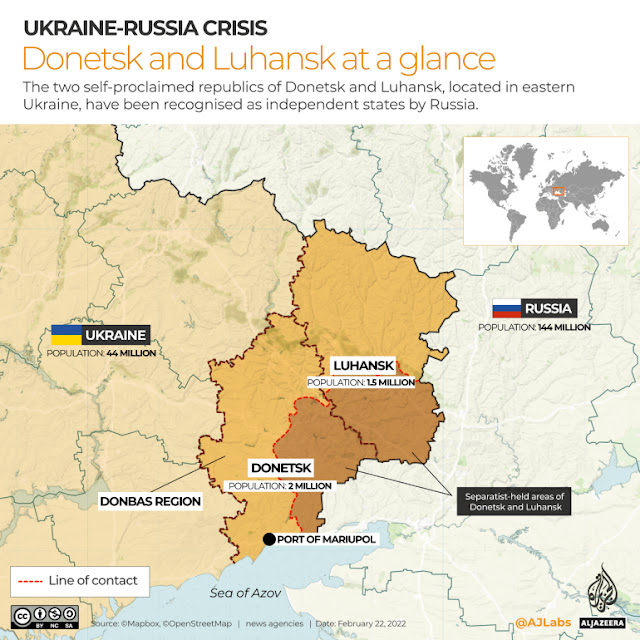
Too many words. There has to be a picture.

While the propaganda kept promoting the Russian failures at this time. For the most part, the 49th, 58th and the 8th Combined Arms Armies (CAA) and were successful in south Ukraine at achieving their objectives. One reason I have read for this was the 49th and the 58th had a large percentage of experienced troops, and performed competently. Once they achieved their objective, they pretty much were allowed to dig in. The 8th CAA, however is a relativity new formation, recruited from Separatists elements from the Donbas region. It performed poorly. Taking 3 months to capture it's main objective of the city of Mariupol, losing 6,000 dead in the process.

What is a Russian Combined Arms Army?

In WWII, an army would have from 5-12 divisions. 6 being pretty normal, plus supporting structures like supply, artillery and communications battalions. Today, to deal with asymmetric warfare, throwing divisions at a problem is just a waste of resources. The divisions still exist, and are fairly recognizable in formation to their WWII equivalent, but their purpose has changed. Their purpose now is to supply and support 1 or more Battalion Tactical Groups to an area. The BTG will be mostly mounted infantry, with integral support of armor and artillery. A tidy little package designed to take on insurgents over a wide area. In theory, a division could supply 9 of these into combat, but over the last decade, they were hard pressed to supply even 2.

In response, divisions were being decommissioned and replaced with brigades. Brigades will have from 2-6 battalions in total, and in theory could create 4 BTG's, though 1-2 in practice. But still represented less overhead than divisions, providing practically the same bang.

The first obvious problem with this is what if you run into a real division? How long will your BTG last in face of a regiment backed by a battalion of artillery? It's a bad accident waiting to happen.

And over the last few month's that is what I am reading. A Ukrainian brigade mauling BTG after BTG.

There is several reasons why the Russians have not been totally routed so far. One is that the Ukrainian Army, despite all the propaganda, is pretty much equipped as the Russians. And they don't have all that many brigades to fight with, and so pretty much have to split them up in battalions just to cover the ground. The second reason is, that for all its incompetency, the Russians have overwhelming numbers of artillery. And are fairly competent in it's use.  This cannot be overstated. From the Ukrainian perspective, they cannot hold ground. If they do, the Russians will pound them. The Ukrainians have difficulty exploiting gaps in Russian lines. Because artillery can pound those gaps. Ukrainians are sensitive to casualties, the Russians are not.

Also, it seems, that while Russia seems to feel the need to need to attack, Ukraine does not at this time. Russian logistics are beyond their breakpoint for the little ground they have taken. Ukraine really is holding much the ground with trip wire defensive's. Many Ukrainian Brigades have been pulled out for reasons unknown. Probably training and up equipping. And when they show up, it will be bad for the Russians. Russian equipment losses are being made up for by digging ever deeper into the Soviet stockpile. Which has been poorly maintained over the decades.

Evidence of this is the missiles fired by their aircraft are sometimes 50 years old. The recent Ukrainian offensive has offered another hint at how deep the Russians have dug. A captured T-62 tank. Produced from 1961 to 1975. Implying they have worked their way through all the operational T-72's in their inventory of around 20,000.

A couple of months ago, Russia started running out of 122mm shells for their medium guns. And had to commission their 152's. With ammunition being now supplied by North Korea.

On Training and Conscription.

The latest call by Putin is to increase conscription by 300,000 men. But what will he get for this call up? Even before the war, the training cycle for conscripts was deceptive. Every six months, Russia would draft about 130,000 men, but only about 100,000 would actually be drafted, and according to one article I read, only about 70,000 complete the training and serve their year.

The Russian training system involves newly trained officers from school to train the platoon, 20-30 men, which they would command. This system has totally broken down due to the high officer casualties. Assuming Russia gets the 300,000 conscripts called for, there are not enough academy grads to train this flood of recruits. The answer of course is to pull veterans from the front lines to train the recruits. But the front lines are already greatly decimated and I am sure commanders would be unwilling to give any up.

How decimated?

For once, the word decimated seems a radical under statement. Some areas have battalion tactical groups (BTG) reporting only a 100 effectives out of 800. The good news is the BTG's were probably never up to strength. Instead of around 800, they may have started at around 500. And in dealing with realities on the ground, the official strength from captured documents has been down sized to around 340. See Here.

The total KIA's the Russians have suffered is subject to debate.  Last month, Russian acknowledged 5,900 dead.  Ukraine's estimate of Russian dead is 50,000.   This is somewhat validated by this document that surfaced earlier in September:

It's in Russian of course.  I am told it is an synopsis of the amount of money paid out to Russian families for killed members.The math is 361.9 billion rubles total, 7.4 million per fallen soldier, for 48,900 KIA's.  The document may be real, but it is still suspect, not because it is falsified, but because of the layers of corruption in the whole system.  Each layer can benefit for padding the numbers here.  Where someone can add to the casualty list, and pocket the 7.4 million per.  This document came out before the latest offensive by Ukraine.

The Ukrainians have claimed to have killed about 50,000 Russians.  But that can be propaganda as well.

Estimates on Ukrainian dead range from 5,500 to 11,000.

Wounded estimates would be from 1 man invalided per dead and at least 2 men wounded, but recoverable per dead.

The War in the Sky

In theory, the Russians should have dominated the air war.  This is again, applying western doctrine to an air-force that is not a western nation.  The Russian doctrine in the air evolved in WWII, and frankly, has not altered much.  In WWII, they would mass fighter bombers over the battlefield, supporting the troops.  Casualties be damned.  Their methods of dealing with German fighter aircraft relied on numbers.  Their main tactic to defeat the Luftwaffe was to never stop fighting, wear it down, and eventually, drive a tank down the runway.  Overall, the single purpose of the Russian Air force is to support the army. 

Western air evolved concepts of trying to defeat the enemies structures supporting the air force.  Be it industry, radars, air fields, etc.  Why they evolved differently is environmental.  The Soviets were nose to nose with the Germans.  And if they drove two hundred miles, they would be in a position to put a tank on the end of a runway.  The need for deep penetration bombers, and supporting long range fighters was simply not there.  

In the west, for two years, the German bases were not vulnerable to ground attack, so different methodology evolved.  When the Western Allies finally got to grips with the Wehrmacht, the doctrines of ground support for the troops had to be evolved whole cloth.  While the Russians had been doing it for 3 years.

It's been 80 years since then.  And frankly, neither side has changed their views on how to fight the air war.  For the Russians, this means ground support.  Occasionally, they send a bomber armed with "Less than precision" guided missiles to bomb a strategic target.  Mostly striking things that couldn't possibly be the intended target.  Of course, we only have the Ukrainians word on what was hit, and the Russians word of what the intended target was.  But the point is, Russian deep penetration strike performance on Ukrainian infrastructure is lack-luster at best.  Because that is not their doctrine.  And the quality and the number of missiles seem to be limited.

In the initial phases of their offensive, the Russian air force was fairly active over the battlefield itself.  Doing what they were trained to do, supporting the troops.  YouTube is full of videos of Ukrainian missiles shooting down Russian craft in the early periods.  About a hundred manned air craft in total.  Mostly lost in low altitude strikes on Ukrainian positions.  The difference between WWII and today is in WWII, the Soviets were producing Sturmoviks by the gross, while today, a single SU-35 costs 60 million dollars.  Every loss is felt.  

Rumor has it, that Russia needs to cannibalize civilian commercial products to get the IC chips needed to build their jets.  Specifically Bosch dish washers looted from Ukrainian homes.

Ukrainian air losses are about the same as Russians in numbers.  But for all the news of this-or-that country donating new Soviet equipment, little has been reported in actually showing up.  Ukrainian fighters seem to be dedicated to air defense.

Drones

The details on the drone war will be the most interesting read when this war is over.  Every country will study the results, most of which is still secret.  

In reconnaissance, drones have proven invaluable.  To be able to target real time, over the horizon targets cannot be understated.  From interdicting supplies with a drone, a M777 howitzer at 18 miles, landing a shell on truck crossing a bridge.  Or distracting a Russian flagship, allowing a couple of missiles blind side it to oblivion.  

Ukraine has an indigenous drone company, formed by veterans of the 2014 War in the Donbas.  They have been turning out "Punishers".  Small, stealthy, carrying only 4.4 pounds of bombs, transportable in small boxes, but in the right location, have blown up helicopters, and ammo dumps.  The unit cost is about $200,000. It is the weapon of choice for Ukrainian special forces.

Then there is the Bayraktar, medium-size drones, made in Turkey, costing about 2 million each.  They can carry 300 pounds of munitions, and have been battle tested in Syria.

Russia has fallen behind so far in drone capability, they are buying them from Iran.

On Corruption

The effects of corruption has come to has been brought to light throughout this war.  Tanks without reactive armor, supply deficiencies, reserve equipment left to rust, missiles that should have been combat worthy, were not, communications equipment not working, divisions only able to send 1 battalion into combat at 75% strength, training commands only training 53% of their yearly muster.  

All evidence that if you were Putin's friend, you had a license to steal.  If you were a friend of a friend of Putin, you could steal, but had to pay your share up the chain.  

Creating an army, when put to the test, is failing badly everywhere.

The Putin Effect

Much is being said of Putin's interference in the war.  More and more it is being said he is directing the army to do this or that.  And this may be true.  But there is a more subtle, and probably more pervasive problem of Putin's interference.  Generals are not taking actions they know need to be done, without Putin's orders.  An example is during the Ukrainian offensive earlier in September.  All of us arm chair strategists looked at what was going on, and seeing disaster for the Ukrainians at every step.  Their penetrations were too deep, not leaving troops to cover Russians they bypassed.  The Russians need only leave their bases and close the door, trapping the Ukrainians behind enemy lines.

And that did not happen.  The shock of the attacks paralyzed the Russian high command.  They waited for orders from on high, and got nothing.  So they hunkered down, and hoped for the best.  

Today, Sept 27, Putin, apparently channeling Hitler from 1941, issued a no step back order for his army.  He is relying on sending reinforcements to the front to stabilize things.  One Russian soldier, was mobilized on the 21st, captured on the 27th.

How is it that Ukraine has not won the war yet?

First, no one expected Ukraine to go the distance.  Probably they themselves are surprised.  So in the beginning, the war was a desperate attempt to stop what Russian juggernaut with what equipment they had on hand.  While dealing with mass migrations, and keeping the lights on against random Russian missile strikes.

It took time for the realities of the Russian army to manifest.  But they still kept moving forward, and had to be responded to.  The Ukrainians got real good at defensive warfare.  As things stabilized, some Ukrainian units disappeared.  Some still have yet to make an appearance.  Others were cycled for rest and reequip, like the 92nd Mech Brigade.  When the war movies are made, the 92nd will be center piece in them.  That unit has been the bane of several Russian armies.  It's commander will be their Patton.  

But the question is, can Ukraine attack?  And we had our answer this month, yes.  But they still have to cautious.  Ukraine is sensitive to casualties, and Russian artillery is still the key player to beat in this game.  

But also, is Ukrainian success on the attack this month an indicator of their effectiveness?  Or of Russian incompetence?  Frankly, the force multipliers of Russian corruption, Putin's interference, and poor training levels is making Ukraine look like supermen.   

The End Game:

What is the end game?  Dangerous ground here to make predictions here.  At this point, I think Ukraine is going to go for recovering all lost territory, including that lost in 2014.  And not one square foot more.  Crossing the Russian border would be a propaganda coup that Putin could capitalize on to legitimized full mobilization, and possibly authorize nuclear strikes.  He is already trying to make claims of Ukrainian agents operating in Russia.  No one believes him, but to provide actual proof is a different matter.  Regardless of how well Ukraine is doing right now, they cannot conqueror Russia. 


Sunday, July 17, 2022

On Hypersonic Missiles

On Hypersonic Missiles

Hypersonic is classified as something traveling faster than 5 times the speed of sound. 3,800 MPH at sea level, about 2,700 MPH at 30,000 feet. Roughly a mile a second. All the great nations are researching hypersonic weapons to some degree or another, and have been for many decades. 

The task is daunting. First, you need an engine capable of generating the thrust. Then the materials capable of withstanding the heat. The thrust of a large rocket engine is more than enough, providing the materials can survive the atmospheric friction. Any of the rockets sent to the International Space Station has to go 5 times that fast. The missiles require exotic materials to survive the heat generated during reentry. But these technologies are decades old, and a secret to no one. 

Both Russia and China are making claims of having Hypersonic Weapons. There is no doubt that they do. China has officially deployed a system, the DF-ZF hypersonic glide vehicle (HGV). Russia has deployed the Avangard. Both of these systems launch from an ICBM rocket to speeds up to mach 20, where they then glide at hypersonic speeds towards their targets. The Russian weapon is more problematic, as it is a strategic weapon, it's target of choice are cities. It probably can do what it is advertised it can do, since it carries a nuke and only needs a to get within a mile of it's target.

The Chinese weapon, has been labeled a carrier killer. And the propaganda is that it can kinetic kill a US aircraft carrier out to 1,800 miles. They have tested the HGV about 7 or so times, each with the propaganda deluge in western press about it's ability to destroy a carrier, at range. It is clear, that this is an attempt to put the fear of this weapon and cause our navy to keep it's distance, as China expands it's influence into the Pacific, and they do not want the competition.

DF-17s on display. Image stolen from the internet without permission

And the USN's response is usually nothing. No denials of enemies capabilities, no counter arguments as to "Well we have...". The propaganda trolls in the east are facing a wall of nothing in response to their claims. It is almost like the USN doesn't really care.

It could be they don't. The USN certainly understands the problems involved with fielding such a weapon, and the threat it imposes. The USN, like it's Chinese counterparts, also understand The Fire Control problem. I was a Fire Controlman 1976-1982. At that time there were 72 variables required to put a shot on the target. This was just a simple ballistic program. Beyond certain ranges, you cannot know all the variables. For long range shots, you have to rely on Mid Course Guidance. Beyond that, Terminal Homing. Without these, all you are going to do is make a big splash in the water.

As an example. The Nimitz is steaming at 20 knots at a range of 1,000 miles. The HGV's time of flight is 8 minutes. If the HGV hit it's precise targeted position, the Nimitz will have moved on 3 miles. Even if the HGV leads the target by 3 miles, the Nimitz will only need to change it's course by .1 degree to avoid being hit. Frankly, the prevailing current will be enough of a jink to cause a miss.

The HGV will need some way to upgrade it's course along the way, referred to as Mid Course Guidance. This will require something putting their eyes on the target, provide feedback to the control systems, which will update the missiles targeting computer. I requires that something is tracking the target. It could be satellite, which would need to be overhead at just the right time. Or a drone. or a high value target like an AWACS.

One thing the current war between Russia and Ukraine has revealed is that drones are going to receive a much high priority in getting destroyed. Any AWACS is going to have a very limited life span when it breaks the radar ring what would be circling Carrier task force in a hot war situation.

Even if there are "eyes on target", getting a guidance signal to an HGV will be difficult as well It's surface temperature will be exceeding the melting point of steel, see Scientific American. This will have the effect of creating ionizing radiation "noise" across a universal spectrum. Getting a signal to update the HGV course becomes problematic. Especially if it is over the horizon.

Accuracy further degrades as the HGV has to deal with being jostled due to it generating random atmospheric vortexes from it's own heat, as well as from the pressure wave in front of it.

Another question is what is the minimum range of these weapons? At ranges where ground systems can provide the guidance updates may be too close for the missile to climb to altitude, then glide back at the speeds necessary to be effective . All missiles have a minimum effective range. For these weapons, that range is going to be excessive. I truly don't know what the minimum range of the HGV is. I have seen Intermediate Ballistic Missile minimum ranges between 240 and 500 miles.

There are estimates that the surface temperature of these missiles will be heated to at least 2,000K, the electronics for this missile will have to be well insulated. Possibly sealed in a Dewar flask. Which also means it is effectively isolated electronically, like in a Faraday cage. The electronics would be vulnerable any break in the control wiring, be it from melting wires, violent shudders, or stretching hull. All of which could disable the mid course guidance systems.

I think the only way this missile works, is they fire and pray the terminal seeker will pick up a signal in the last 15 seconds of flight. The terminal seeker will have to be shielded for most of the flight, and uncovered just in time. It has to be able to "see" the target through the shock wave of compressed, heated gas in front of it, before extreme temperatures destroy the delicate sensors required. Then they have to hope their aileron surfaces didn't weld together, or their electronics didn't fry. Because at these speeds, this missile cannot maneuver too much, because it could come apart from the forces involved.

I have some experience with near hypersonic missiles. In the late 70's, I was a Fire Controlman for both the Talos and Terrier Surface to Air missile radars. Both of these missiles are capable of speeds in excess of mach 2. In 1980, the USN was retiring the Talos system. And it was decided to spend the Talos missile inventory as targets for other ships and planes. 

Talos missiles are powered by ramjets, and could travel at mach 2.5. There were at least 3 such "Buzzard Ex's". In total, about 4 of these missiles were shot down. Two by the Terrier Mod 8 systems on the the USS Jouett, CG-29 and the USS Dale, CG-19. A third was shot down by the Norton Sound, the test ship for the future Aegis system. For a more humorous sides of these operations, see Buzzard Ex and Spontaneous Teleportation.

Admittedly, Talos is only half the speed of what is considered hyper sonic, but this was also over 40 years ago, using equipment designed in the 50's, later updated in the late 70's.

In 2008, using a SM-3, an Aegis equipped ship, the USS Lake Erie, intercepted a satellite with a kinetic kill warhead. The satellite USA-193 was traveling at 4.8 miles per second, about mach 23, when intercepted.The actual target was not the satellite, but a specific spot of the satellite that would fragment the fuel tank. Causing it to fragment as to vaporize the hydrazine in the upper atmosphere.

The US Navy is now deploying 30 kw lasers, capable of shooting down sub sonic missiles. There are higher powered lasers, planned, up to 300kw. The 300 kw probably would be powerful enough to shoot down an HGV. Hypersonic missiles cost many millions to produce. The lasers are a buck or two a shot.

It could be the Chinese weapon system is only effective as a propaganda weapon. designed just in time to be obsolete. Such is rapidly advancing technology.